Steel Warehouse Cost in Mexico:
Factors, Budget Ranges & How to Get a Real Quote
One of the first questions any company planning industrial construction in Mexico asks is: how much will this cost? This guide doesn't give you a price — no honest contractor can do that without knowing your site, size, and specs. What it gives you is a framework for understanding what drives cost, realistic budget ranges for planning purposes, and a clear picture of how Mexico compares to US construction costs.
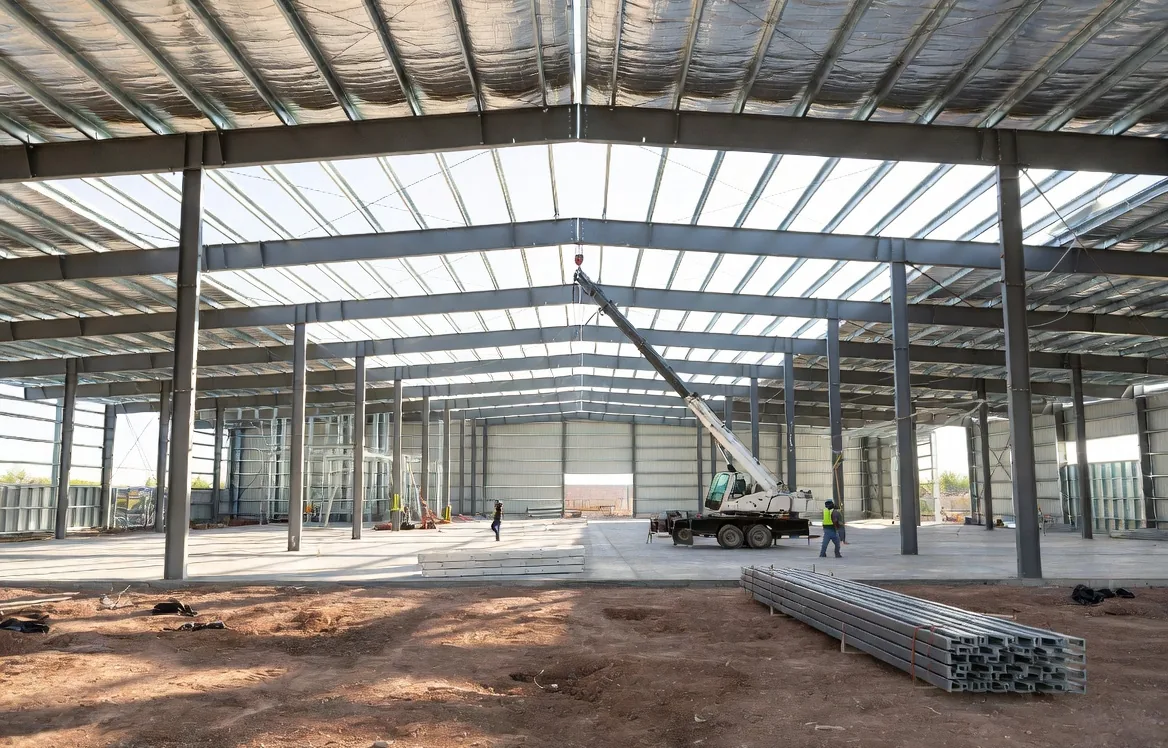
What Does Steel Warehouse Construction Actually Cost in Mexico?
Pre-engineered steel buildings (PEMB) in northwest Mexico — Sonora, Chihuahua, Baja California — run broadly in the range of $12 to $30 USD per square foot installed, including foundation. That's a wide range because the variables are significant. A 5,000 sq ft modular storage building and a 50,000 sq ft automotive manufacturing plant with overhead cranes, dock equipment, and insulated panels are both "steel warehouses" — they just cost very different amounts per square foot.
The table below gives planning-level ranges by building size for standard industrial construction in Sonora. These assume a straightforward site, standard cladding, slab-on-grade foundation, and no overhead crane system. Each adder (crane, insulated panels, mezzanine, dock levelers) adds to the base.
Budget Ranges by Building Size — Northwest Mexico (USD, 2026)
| Building Size | Type | Budget Range (USD) | $/Sq Ft | Typical Use |
|---|---|---|---|---|
| 2,500 – 5,000 sq ft | Small industrial / storage | $35,000 – $90,000 | $14–$22 | Modular or standard-bay systems. Typical for small maquiladoras, storage annexes, equipment shelters. |
| 5,000 – 20,000 sq ft | Light industrial / warehouse | $80,000 – $400,000 | $16–$22 | PEMB standard range. Assembly, logistics, regional distribution. Most common size for new nearshoring operations. |
| 20,000 – 60,000 sq ft | Industrial PEMB | $350,000 – $1,200,000 | $18–$25 | Manufacturing plants, Tier 1/2 automotive suppliers, food processing. May include crane, mezzanine, dock equipment. |
| 60,000 – 150,000 sq ft | Large industrial / distribution | $1,100,000 – $3,500,000+ | $18–$30 | Distribution centers, large manufacturing. Cost varies significantly based on clear height, crane capacity, and cladding. |
* Planning-level ranges only. Assumes standard slab-on-grade, single-skin galvanized cladding, standard eave height (20–24 ft), no crane. Ranges widen significantly with special requirements. See cost factors below.
7 Factors That Drive Steel Warehouse Cost
Understanding these factors lets you make smarter early decisions — and avoid the projects where a small spec change doubles the cost.
Building size
Economy of scale is significant in steel construction. A 5,000 sq ft building costs more per sq ft than a 50,000 sq ft building with identical specs — the fixed costs of engineering, mobilization, and foundation work spread over more area.
Clear span width
A 60 ft clear span building uses significantly lighter steel than a 120 ft clear span at the same length. Wide-span manufacturing floors and logistics buildings cost more per sq ft than narrow bays.
Eave height
Standard industrial eave heights run 18–24 ft. Every additional 4 ft of height adds wall cladding area and increases column moment demands, driving up both steel weight and panel quantity.
Cladding specification
Single-skin galvanized sheeting is the lowest-cost cladding. Insulated sandwich panel (PIR or mineral wool) for temperature-controlled facilities can add $3–$6/sq ft to the building cost but eliminates separate insulation installation.
Foundation type
A standard slab-on-grade with perimeter grade beam is the baseline. Rocky ground near Hermosillo is favorable. Soft or expansive soils (some areas near Guaymas coast) may require deep piers or ground improvement, adding significant cost.
Overhead crane system
A single 10-ton bridge crane system (rails, end trucks, hoist) adds $40,000–$120,000 USD to the project depending on span and capacity, plus the reinforced frame it requires.
Site access and location
Established industrial parks in Hermosillo (PIMSA) and Guaymas have infrastructure in place. Remote or greenfield sites may require road improvement, utility extension, or extended mobilization time.
Mexico vs US Construction Cost: The Real Comparison
The cost advantage of building in Mexico is real but often misunderstood. It's not across the board — it's concentrated in specific line items.
| Cost Component | Mexico (Sonora) | US (Southwest) | Difference |
|---|---|---|---|
| Structural steel fabrication | Competitive | Similar | ~10–20% lower in MX |
| Erection / installation labor | Significantly lower | Higher | 30–50% lower in MX |
| Foundation / civil work | Lower | Higher | 25–40% lower in MX |
| Steel material cost | Similar (ASTM A-36) | Similar | Comparable |
| Cladding / panels | Similar | Similar | Comparable |
| Permitting timeline | Faster in established parks | Varies by jurisdiction | Often faster in MX parks |
| Total installed cost | $12–$30/sq ft | $20–$50+/sq ft | 30–50% lower in MX |
The labor cost differential is the primary driver. Structural erection crews, foundation teams, and site labor in northwest Mexico cost a fraction of US equivalents — and this is where 40–60% of a steel building project's cost sits. Material costs (steel, cladding, fasteners) are largely comparable since both markets source from the same global supply chain. See also: manufacturing in Mexico — industrial construction guide.
What Building Cost Estimates Usually Don't Include
Budget ranges like those above typically cover structure, cladding, and foundation. On larger projects with overhead cranes, process equipment, or extensive HVAC, design-side Revit MEP drafting is usually handled before fabrication releases so service runs don't fight the structure later. These items are usually quoted separately and can add 15–40% to the building cost:
Site preparation & grading
Leveling, compaction, drainage. Highly variable by site conditions.
Utilities & electrical rough-in
Power entry, lighting conduit, compressed air — not in structural quote.
Overhead crane system
Bridge crane, rails, end trucks, hoist. Quoted separately; adds $40k–$120k+.
Dock equipment
Dock levelers, dock seals, vehicle restraints. Per-door pricing.
Mezzanine / office buildout
Interior office, mezzanine floor, interior partition walls.
Permits & engineering fees
Municipal permits, structural engineering stamp. Varies by municipality.
Insulated panel upgrade
Replacing single-skin with sandwich panel for temperature control.
Paving & exterior works
Yard paving, truck courts, fencing, landscaping.
How to Get an Accurate Quote (Not a Range)
Budget ranges get you to the right ballpark. A real quote requires four things:
A site location or address
Foundation cost and logistics depend heavily on soil conditions, site access, and distance from the fabrication facility. Hermosillo-area sites are the most efficient for SQ Tech.
A target footprint
Length × width in feet or meters. Clear span (no interior columns) or multi-bay. Eave height.
Intended use
Storage, manufacturing, automotive assembly, food processing — each has different load, clear height, and cladding requirements that affect cost significantly.
Any special requirements
Overhead crane (capacity and span), dock doors, mezzanine, insulated panels, fire suppression, office area.
SQ Tech provides a preliminary cost range within 24–48 hours of receiving the above information — no commitment required. A full proposal with structural layout, material schedule, and fixed price follows after a site visit or engineering review. Start the conversation here →
Related guides
Ready for a project-specific estimate?
Tell us your footprint, location, and intended use. We'll come back with a preliminary range within 24 hours — no commitment, no hard sell.
Get a Free Estimate