
Process guide · Updated September 2026 · 9 min read
Steel Warehouse Construction: How the Build Process Works
Steel warehouse construction is the design, shop fabrication and site assembly of a structural steel frame and its cladding. A typical build runs in four stages: engineering and permit drawings (2–4 weeks), steel fabrication (3–6 weeks), foundations and site work (2–4 weeks, overlapping fabrication), and erection and cladding (2–5 weeks). From engineering to handover that is usually 8 to 20 weeks, depending on size and complexity.
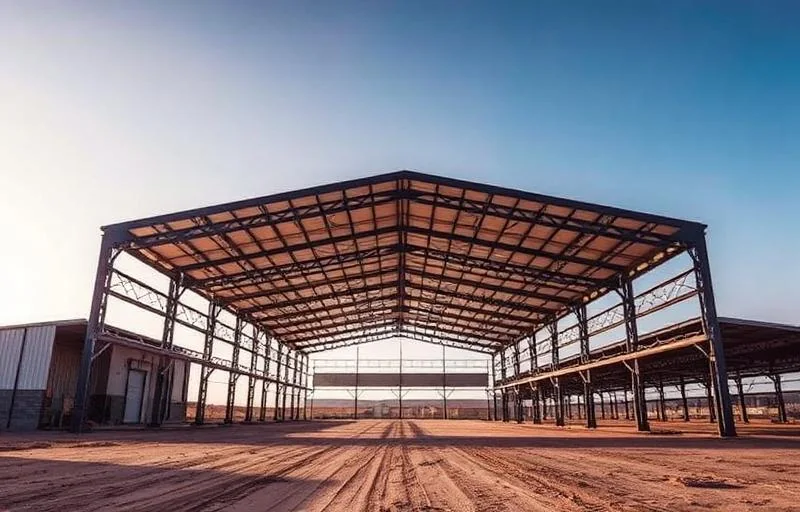
Stage 1: loads, engineering and permit drawings
Every steel warehouse starts with the structural design: the loads of the site and the use, then the frames, connections and foundations that carry them. On complex jobs the detailing package includes structural shop drawings issued for review before steel is cut. The deliverables:
- Structural calculation package: wind, seismic, snow, dead and live loads per the code that governs the site
- Shop drawings: every member with its bolt patterns and weld details
- Foundation data: anchor-bolt layout, base-plate dimensions and the reactions the footings must carry
- Permit drawings: architectural and structural sheets formatted for the building department
In Mexico the design follows the municipal building regulations, with wind and seismic loads from the CFE's Manual de Diseño de Obras Civiles; a building for a US site follows the IBC edition adopted there. The codes and wind design guide sets the two side by side.
Stage 2: steel fabrication
Once the shop drawings are approved, fabrication starts in our Hermosillo plant:
- Material: ASTM A36 or A572 Grade 50 structural steel from Mexican mills, with mill test reports
- Cutting: CNC plasma or oxy-fuel for plate; band saw for beams and tubes
- Welding: to AWS D1.1
- Drilling: bolt holes to the shop drawings, for a clean fit-up in the field
- Surface preparation and primer, paint or galvanizing to the specification
- Quality control: dimensional and weld checks before the steel is loaded
Fabricating in our own plant keeps the schedule and the quality under one roof. Typical fabrication lead times are 3 to 6 weeks, depending on tonnage.
Stage 3: foundations, anchor bolts and site preparation
Foundations are built while the steel is in the shop, which shortens the job. The anchor-bolt plan reaches the site first, so the bolts are cast in the right place:
- Grading and compaction to the engineered specification
- Excavation for isolated or strip footings
- Reinforced concrete footings with the anchor bolts cast in to the anchor-bolt plan
- Floor slab, typically 6 in. reinforced concrete finished to industrial flatness
- Underground utilities: drainage, electrical conduit and plumbing rough-in
Stage 4: erection and cladding
With the foundations cured and the steel on site, erection follows a set sequence:
- Anchor-bolt survey and base-plate alignment
- Primary frames: columns and rafters lifted by crane and connected with high-strength bolts
- Secondary framing: purlins and girts bolted to the frames
- Roof panels: standing-seam or through-fastened
- Wall cladding: metal sheeting or insulated sandwich panels
- Accessories: trim, gutters, doors, windows and ventilators
How long steel warehouse construction takes
| Building size (sq ft) | Total timeline | Erection phase |
|---|---|---|
| 1,000–5,000 | 8–12 weeks | 1–2 weeks |
| 5,000–20,000 | 10–16 weeks | 2–4 weeks |
| 20,000–50,000 | 12–18 weeks | 3–5 weeks |
| Over 50,000 | 16–24 weeks | 4–8 weeks |
A kit on a US site: who does what
When we ship a prefab steel building kit to a US site, the four stages stay the same but the work splits:
- We engineer the building to the IBC edition your jurisdiction has adopted and send the calculation package; your engineer of record reviews and stamps it for the permit.
- We send the anchor-bolt plan and reactions ahead of the steel; your foundation engineer designs the footings and your contractor pours them.
- We fabricate, mark and bundle the steel in erection sequence and ship it at the plant, the border or DDP to your site.
- Your own crew or a local erector puts the building up from our erection drawings.
Steel building delivery explains the three delivery terms and the customs documents.
What moves the cost
| Factor | Effect | Notes |
|---|---|---|
| Building size | High | Larger buildings cost less per square foot |
| Design loads | High | Wind, snow and seismic loads of the site set the frame sizes |
| Steel grade | Medium | A572 Grade 50 costs more per ton than A36 but allows lighter sections |
| Insulation | Medium | Insulated sandwich panels cost more than single-skin sheeting |
| Cranes | High | Crane loads need heavier frames and often taller eaves |
| Location | Medium | Remote sites add freight and crew mobilization |
Budget ranges by footprint are in the steel building cost guide.
Design-build or separate trades
| Factor | Design-build | Separate trades |
|---|---|---|
| Cost control | One contract, no stacked markups | A markup at each link of the chain |
| Schedule | Fabrication overlaps the foundations | Sequential, with hand-offs between firms |
| Accountability | One point of contact | Split between designer, fabricator and erector |
| Quality | One team from drawings to erection | Varies by firm |
| Best for | Industrial buildings | Small, simple structures |
SQ Tech works design-build, with its own engineering, fabrication plant and erection crews in Sonora, for prefabricated steel warehouses and industrial buildings.
Questions
How long does steel warehouse construction take?
Typically 8 to 20 weeks from engineering to handover, depending on size and complexity: 2–4 weeks of engineering and permit drawings, 3–6 weeks of fabrication, 2–4 weeks of foundations (overlapping fabrication) and 2–5 weeks of erection and cladding.
What are the main stages?
Engineering and permit drawings, shop fabrication of the steel, foundations and site work, then erection of the frame and the roof and wall cladding, followed by handover.
How is a kit built on a US site different?
The stages are the same, but the paperwork splits: your engineer of record reviews and stamps our calculation package for the permit, your foundation engineer designs the footings from our anchor-bolt plan and reactions, and your own crew or a local erector puts the building up from our erection drawings. How our kits work.
Should I choose a design-build contractor or separate trades?
Design-build gives one point of accountability and lets fabrication overlap the foundations, which shortens the schedule. Separate trades can work for small, simple buildings but add coordination between the designer, the fabricator and the erector.
SQ Tech · Hermosillo, Sonora
Planning a steel warehouse?
Send the size, the site and the use. We engineer, fabricate and erect in Sonora, and ship kits to US sites.