Industrial Steel Buildings in Mexico: A US Buyer's Guide to Standards, Erection, and Contractors
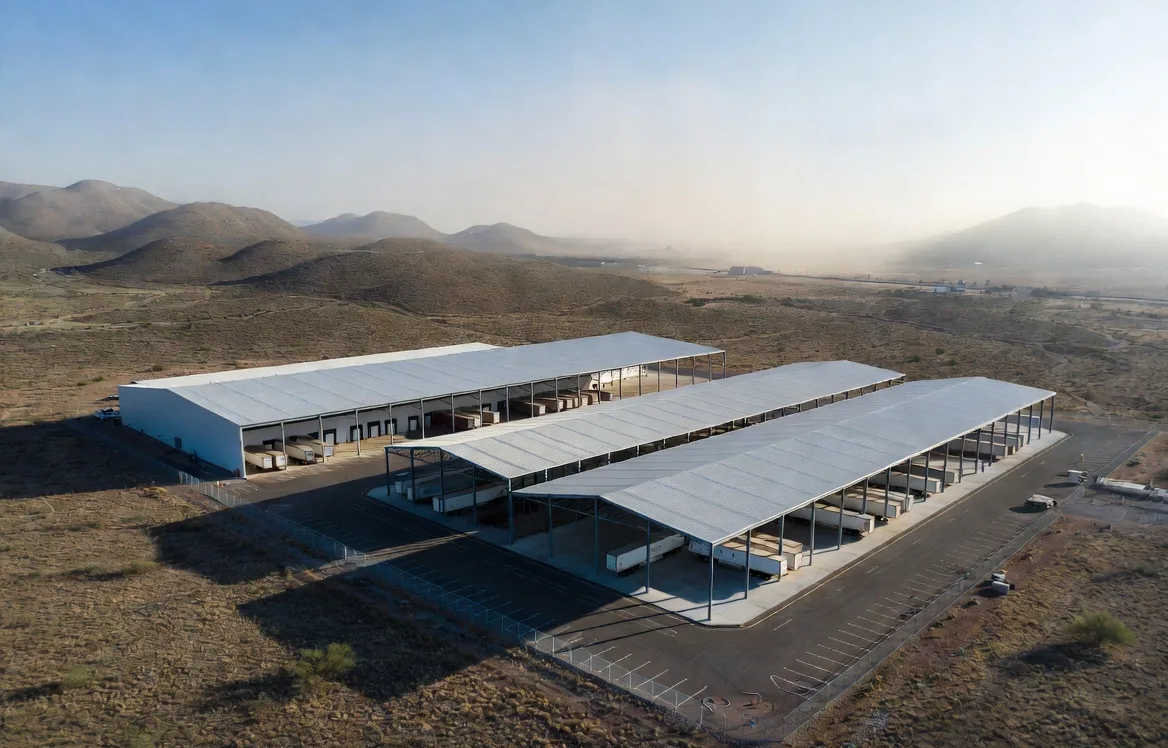
Industrial steel buildings in Mexico are engineered structural steel facilities used for manufacturing, logistics, warehousing, and processing operations. They are designed to Mexican NMX structural standards and can meet ASTM A36/A572 specifications when required for cross-border projects. In Sonora, pre-engineered metal buildings (PEMB) and custom structural steel systems are the dominant industrial construction method, with typical clear-span widths of 60 to 300 ft and eave heights of 18 to 40 ft. Build times range from 8 to 18 weeks depending on size and site conditions.
Standards and certifications: NMX, ASTM, and AISC
Mexican industrial construction follows a dual-standard framework. Domestic buildings must comply with NMX standards (Normas Mexicanas) for structural design, wind resistance, and seismic performance. For US companies building in Mexico, projects can also be designed to meet American standards:
| Standard | Scope | When Required |
|---|---|---|
| NMX-C-407 / NTC | Concrete and steel structural design | All Mexican construction |
| ASTM A36 | Carbon structural steel | Standard grade specification |
| ASTM A572 Gr 50 | High-strength low-alloy steel | When lighter sections are needed |
| AISC 360 | Steel building design specification | When US corporate policy requires it |
| AWS D1.1 | Structural welding code | All structural steel welding |
| IBC (International Building Code) | US building code reference | Cross-border compliance projects |
PEMB vs. custom engineered systems in Mexico
| Factor | PEMB | Custom Structural Steel |
|---|---|---|
| Design approach | Software-optimized templates | Project-specific engineering |
| Clear span | Up to ~200 ft | 400+ ft |
| Crane support | Light duty (≤10 ton) | Any capacity |
| Lead time | 4–10 weeks | 8–20 weeks |
| Best for | Standard commercial/light industrial | Manufacturing, logistics, heavy industry |
| Cost/sq ft | $8–$15 | $12–$28 |
For nearshoring projects serving US automotive and aerospace companies, custom structural steel is typically required due to crane loads, specialized ventilation, and floor load requirements that exceed PEMB capabilities. These projects also benefit from BIM modeling services earlier in the design phase, so steel, MEP, and process equipment are clash-coordinated before fabrication releases.
How to source a steel building contractor in Sonora
- Design-build capability: the contractor should handle engineering, fabrication, and erection in-house
- Own fabrication shop: ensures quality control and schedule reliability — avoid brokers who subcontract everything
- English-language communication: essential for US buyers managing projects remotely
- Track record with US clients: ask for references from American companies
- Welding certifications: AWS D1.1 compliance is non-negotiable for structural steel
- Insurance and bonding: verify adequate coverage for industrial construction projects
Key construction hubs: Hermosillo, Nogales, Guaymas
| City | Advantages | Key Industries |
|---|---|---|
| Hermosillo | State capital, largest talent pool, established industrial parks | Automotive (Ford), aerospace, logistics |
| Nogales | Direct US border crossing, IMMEX/maquiladora infrastructure | Manufacturing, fresh produce logistics |
| Guaymas | Deep-water port, Tetakawi industrial cluster | Automotive suppliers, port operations |
Timeline from design to occupancy
| Phase | Duration | Key Activities |
|---|---|---|
| Project scoping | 1–2 weeks | Requirements, site evaluation, budget alignment |
| Engineering & permits | 2–4 weeks | Structural design, permit applications |
| Fabrication | 3–6 weeks | Steel cutting, welding, coating (in-house) |
| Foundation | 2–4 weeks | Earthwork, concrete, anchor bolts (overlaps fabrication) |
| Erection & cladding | 2–5 weeks | Crane operations, steel bolt-up, panel installation |
| MEP & finish | 2–4 weeks | Electrical, plumbing, doors, paint |
| Total | 10–20 weeks | Varies by size and complexity |
Commercial steel erection in Mexico
Commercial steel erection is the on-site process of unloading, lifting, plumbing, and bolting structural steel components into the final building frame. In Mexico, steel erection companies are typically separate from fabricators — but for industrial projects, hiring a single design-build contractor that handles both fabrication and erection in-house is the most reliable way to protect schedule and welding quality.
Typical erection sequence and timeline
- Anchor bolt verification and shimming — 1 to 2 days
- Column setting and temporary bracing — 2 to 5 days for a typical 20,000 sq ft building
- Primary rafter and rigid-frame erection — 3 to 7 days
- Secondary framing: purlins, girts, eave struts — 3 to 6 days
- Roof and wall cladding installation — 5 to 15 days depending on cladding system
- Final torque, plumb verification, and punch list — 2 to 4 days
Crane requirements by building size
| Building footprint | Typical clear span | Crane capacity | Reach |
|---|---|---|---|
| Up to 10,000 sq ft | Up to 60 ft | 30–50 ton hydraulic | Standard boom |
| 10,000–40,000 sq ft | 60–120 ft | 50–90 ton hydraulic | Boom + jib |
| 40,000–100,000 sq ft | 120–200 ft | 90–150 ton hydraulic | Long boom + jib |
| 100,000+ sq ft or heavy frames | 200+ ft | 150–300 ton crawler | Tandem lifts possible |
How to evaluate a steel erection company
- Owned (not rented) crane fleet for projects above 20,000 sq ft
- AWS D1.1 certified field welders for any field-welded connections
- Documented rigging plan signed by a qualified rigger
- Active workers' compensation (IMSS) and third-party liability coverage
- Field crew supervisor with at least 5 years of industrial steel erection experience
Heavy steel fabrication capabilities
Heavy steel fabrication for industrial projects involves built-up sections, plate girders, large baseplates, and welded box columns that exceed the capacity of standard PEMB lines. SQ Tech's Hermosillo shop fabricates plate up to 2 in. thick, built-up I-sections up to 60 in. deep, and welded box columns for crane-supporting frames — all under in-house AWS D1.1 quality control. This is the capability required for automotive stamping plants, aerospace assembly halls, and mining process buildings, where PEMB templates cannot meet the design loads.
How to manage a Mexico construction project from the US
- Choose a single-source contractor (design-build) to minimize coordination
- Establish weekly progress reporting with photos and milestone tracking
- Define communication protocol: English-language project manager as single point of contact
- Set clear payment milestones tied to construction phases, not calendar dates
- Plan 1–2 site visits at key milestones (foundation completion, steel erection)
- Use video calls for design reviews and approval meetings
SQ Tech works with US companies throughout this process. Our team provides English-language project management, weekly photo reports, and handles all local permits and coordination. See our prefabricated steel warehouse services for more details on our capabilities.
FAQs for US buyers
What standards apply to industrial steel buildings in Mexico?
NMX structural standards are mandatory. Projects can also meet ASTM, AISC, and IBC when required by US corporate policy.
PEMB or custom steel — which should I choose?
PEMB for standard commercial/light industrial. Custom structural steel for manufacturing, logistics, or any project with cranes or heavy loads.
How do I manage the project from the US?
Work with a design-build contractor that provides English communication, weekly progress reports, and manages all local permits.
Building in Mexico? We're Your Local Partner
SQ Tech is headquartered in Hermosillo with in-house engineering, fabrication, and installation. We serve US companies expanding into Mexico.